Deconstructing Nearshore Pricing Architectures: How Flat Fees Compare to Legacy Models
To maximize engineering output while maintaining budget predictability, enterprise procurement teams must evaluate the systemic differences between contemporary transparent pricing and legacy staffing agency structures. Most market offerings fall into three distinct categories.
1. Time & Materials (T&M) / Blended Hourly Rates
The most common model utilized by traditional IT staff augmentation vendors. The client is billed a flat hourly rate per developer (e.g., $75/hour).
The Hidden Mechanics: The vendor blends the engineer’s salary, recruitment overhead, compliance costs, and their own profit margin into a single figure.
The Structural Risk: Incentives are fundamentally misaligned. Because vendor margins increase when cheaper talent is placed at the same bill rate, enterprise buyers often receive lower-tier talent while paying premium rates.
2. Traditional Cost-Plus Models
In a standard cost-plus model, the vendor discloses the base developer salary and adds a percentage-based markup (typically 30% to 50%) to cover operational infrastructure and overhead.
The Hidden Mechanics: The agency's profit scales linearly with the developer's seniority.
The Structural Risk: The vendor is disincentivized from helping you negotiate market-accurate salaries. If you require a principal software architect with a high base salary, the vendor’s profit margin balloons arbitrarily, penalizing you for scaling senior talent.
3. Stand8 Flat Transparent Management Fee
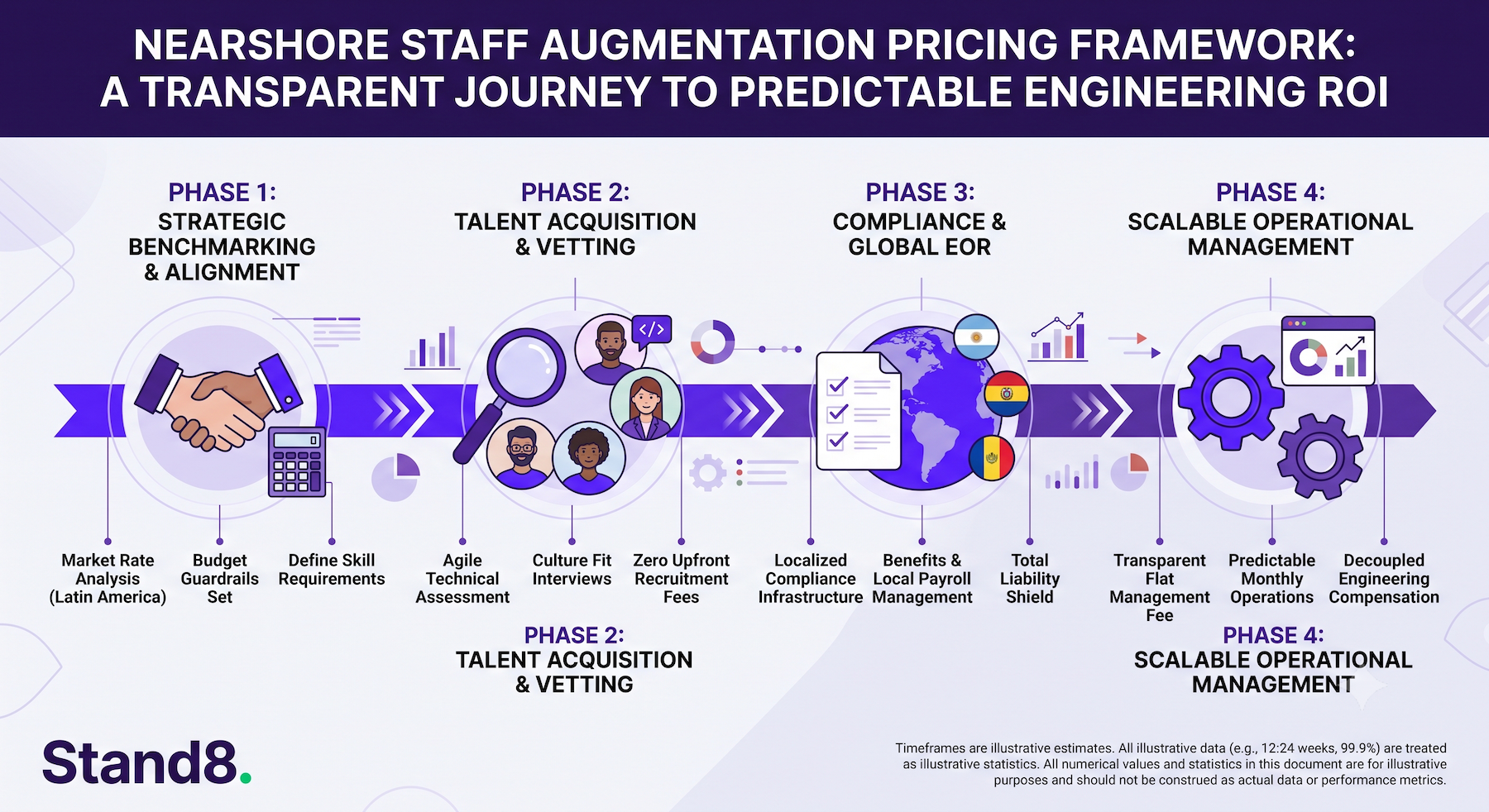
The modern enterprise benchmark for financial predictability. Developer compensation is completely decoupled from operational management.
The Hidden Mechanics: You pay the exact, un-marked-up local market salary directly to the engineer, paired with a fixed, predictable monthly operational fee per head.
The Structural Advantage: Zero misaligned incentives. Scaling from a junior QA engineer to an AI/ML specialist shifts your developer compensation expenditure based purely on market rates, while your administrative overhead remains perfectly flat and predictable.
Pricing Model
Margin Transparency
Scalability Incentives
Budget Predictability
Talent Retention Control
Blended Hourly (T&M)
Completely Opaque
Poor (Vendor profits from cheaper talent)
Low (Subject to variable hour tracking)
None (Developer compensation is hidden)
Traditional Cost-Plus
Partially Transparent
Poor (Vendor profits from higher base salaries)
Medium (Fluctuates dynamically with seniority)
Low (Markup strains client budget)
Stand8 Flat Management Fee
100% Transparent
High (Flat fee prevents margin scaling)
High (Fixed administrative line-items)
Maximum (100% of salary scales talent)
4. Geographic Cost Variations Across Latin American Tech Hubs
Nearshore staff augmentation pricing fluctuates based on localized economic factors, talent density, and regional infrastructure within major Latin American software engineering hubs. When optimizing engineering budgets, enterprise buyers should benchmark total compensation expectations against these critical markets.
Mexico (Tier 1 Hub): Positioned at the center of USMCA compliance frameworks, Mexico offers absolute real-time alignment with US time zones. Senior software engineers and cloud architects average monthly compensation models ranging from $5,500 to $9,500 depending on specialization, with structural payroll taxes and local statutory compliance fees averaging 12% to 18%.
Brazil (High-Scale Tech Hub): Boasting the largest technical talent pool in Latin America, Brazil is highly sought after for complex data engineering and enterprise platform modernization. Monthly senior developer compensation benchmarks parallel Mexico ($5,800 to $10,000), though navigation of complex local labor laws requires a partner with deep local EOR infrastructure.
Colombia & Argentina (Emerging High-Value Hubs): Offering exceptional English proficiency and strong cultural alignment, these regions present highly competitive cost structures, with senior developer rates averaging $4,500 to $8,000 monthly, allowing scaling enterprises to stretch operational runways without sacrificing technical velocity.
Unmasking Hidden Costs in Traditional Augmentation Agreements
An execution strategy built solely on top-line hourly rates frequently falls prey to backend cost leakage. To calculate true total cost of ownership (TCO), engineering leaders must audit potential vendors for these four structural hidden fees:
Major Cost Leakage Vectors to Watch For
Platform Subscription & Setup Fees: Many legacy talent marketplaces assess mandatory upfront implementation deposits or ongoing software platform subscription fees ranging from $500 to $1,000+ per month on top of standard engineering rates.
Contractual Buyout & Conversion Penalties: If an augmented nearshore engineer integrates seamlessly into your product roadmap, you may eventually want to convert them to a permanent internal employee. Traditional agencies block this transition with steep buyout fees, often demanding 20% to 25% of the engineer’s first-year annualized salary.
Infrastructure & Equipment Markups: Hardware procurement, secure laptop deployment, and localized IT compliance configurations are frequently billed back to the client at marked-up rates, rather than being absorbed by the vendor's operational overhead.
Uncapped Annual Rate Escalations: Review contracts for automatic, compounding annual rate increases. Uncapped clauses can cause your nearshore team costs to outpace local market inflation by 8% to 12% annually without an equivalent increase in technical delivery.
Strategic Evaluation Framework for Enterprise Buyers
Before executing a Master Services Agreement (MSA) with a nearshore staff augmentation partner, utilize this operational checklist to audit the underlying financial architecture of your contract.
[ ] Itemized Billing Transparency: Does the vendor provide a clear line-item breakdown separating developer compensation, statutory benefits, and their operational overhead?
[ ] Buyout Transparency: Is the permanent hiring conversion path defined upfront with fixed, below-market buyout rates, or are there hidden conversion penalties?
[ ] Hardware Sourcing Protection: Is secure, enterprise-grade hardware procurement and local logistical distribution included within the management fee, or billed as a separate surcharge?
[ ] Time-to-Hire Accountability: Does the vendor bear the financial overhead of talent sourcing and technical vetting, or are there upfront structural recruitment fees before a developer is successfully onboarded?
[ ] Scale Stability Clauses: Are margin markup structures explicitly capped to prevent arbitrary cost inflation when scaling senior or highly specialized engineering talent?
Accelerate your digital transformation with AWS managed services,AWS consulting and staffing solutions. Including cloud migration and strategy. Reduce TCO, scale faster, and optimize IT performance today.
AND MANY OTHERS
Technology is key to transformation and growth. Our global partnerships deliver cutting-edge technological solutions tailored for today and tomorrow. Together, we unlock potential, drive progress, and redefine your industry's future.
Scale your engineering team with Stand8’s nearshore QA staff augmentation. Access top-tier tech talent, slash costs, and accelerate software delivery.
Nearshore Staff Augmentation in Austin
Tired of competing for engineering talent in Austin? Accelerate your dev cycles with Stand8. We help Austin tech organizations eliminate timezone friction, bypass local hiring bottlenecks, and scale seamlessly with premium nearshore staff augmentation.
Nearshore Staff Augmentation in Philadelphia
Tired of competing for engineering talent in Philadelphia? Accelerate your dev cycles with Stand8. We help Philly tech organizations eliminate timezone friction, bypass local hiring bottlenecks, and scale seamlessly with premium nearshore staff augmentation.
Nearshore Staff Augmentation in Denver
Tired of competing for engineering talent in Denver and Boulder? Accelerate your dev cycles with Stand8. We help Colorado tech organizations eliminate timezone friction, bypass local hiring bottlenecks, and scale seamlessly with premium nearshore staff augmentation.
Nearshore Staff Augmentation in Atlanta
Tired of competing for local tech talent in Atlanta's tight market? Accelerate your dev cycles with Stand8. We bridge the gap, helping Atlanta firms bypass hiring bottlenecks and access elite Mexican developers with zero timezone friction.
Nearshore Staff Augmentation in San Francisco
Accelerate your development cycles with Stand8. We help San Francisco and Bay Area technology organizations eliminate timezone friction, bypass local hiring bottlenecks, and access elite Mexican technical talent with our premium nearshore staff augmentation services.
Nearshore Staff Augmentation in Washington DC
Accelerate your development cycles with Stand8. We help Washington, D.C. organizations eliminate time zone friction and access elite Mexican technical talent with our premium nearshore staff augmentation services.
Nearshore Staff Augmentation in New York
Accelerate your development cycles with Stand8. We help you eliminate time zone friction and access elite Mexican technical talent with our premium nearshore staff augmentation services.
Nearshore Staff Augmentation in Dallas
Accelerate your development cycles with Stand8. We help you eliminate time zone friction and access elite Mexican technical talent with our premium nearshore staff augmentation services.
Let’s Discuss What’s Next
Whether you're scaling teams or optimizing systems, we’re here to partner on your success.



.png)
.svg)


.svg)